ResNet, reproduced
The CIFAR-10 architecture of §4.2 rebuilt from the paper's description, checked against Table 6, and run twenty-two times to find which parts of the degradation claim survive reseeding.
WORK
Projects, research, and notes — filter by kind to narrow the list.
The CIFAR-10 architecture of §4.2 rebuilt from the paper's description, checked against Table 6, and run twenty-two times to find which parts of the degradation claim survive reseeding.
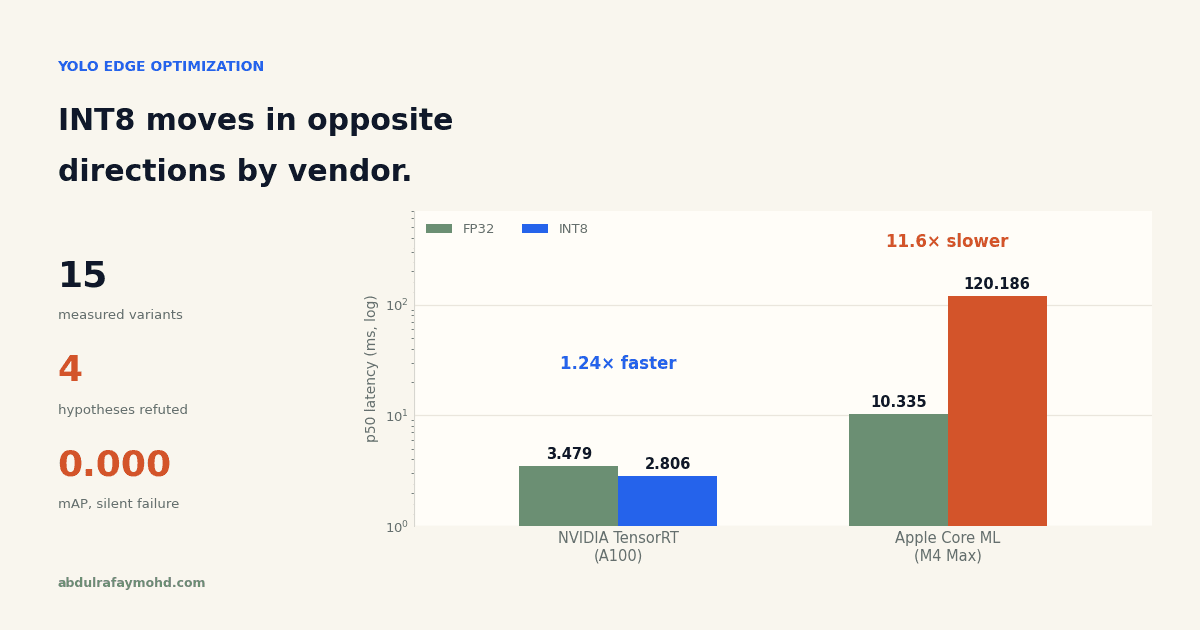
Took a YOLO detection model from research checkpoint to deployment across three accelerators and four runtimes, measuring what every optimization actually costs in latency, accuracy, and size. Found that export is 3.50× faster on NVIDIA TensorRT and 1.69× slower on Apple Core ML for the identical graph, and traced the regression to ten tensor-indexing operators in the NMS-free detection head that split the Core ML graph into eight partitions instead of five. Naive INT8 quantization collapsed the head to 0.000 mAP across all 5,000 COCO validation images without raising a single error; excluding 95 head nodes recovered it, and TensorRT quantized the same head successfully, establishing the failure as a quantizer limitation rather than an architectural one. Six findings documented alongside five hypotheses that failed under testing.
Six configurations rebuilt from Table 1, four of the paper's prose claims measured, and Table 5's protocols reproduced on all 50,000 ILSVRC-2012 validation images.
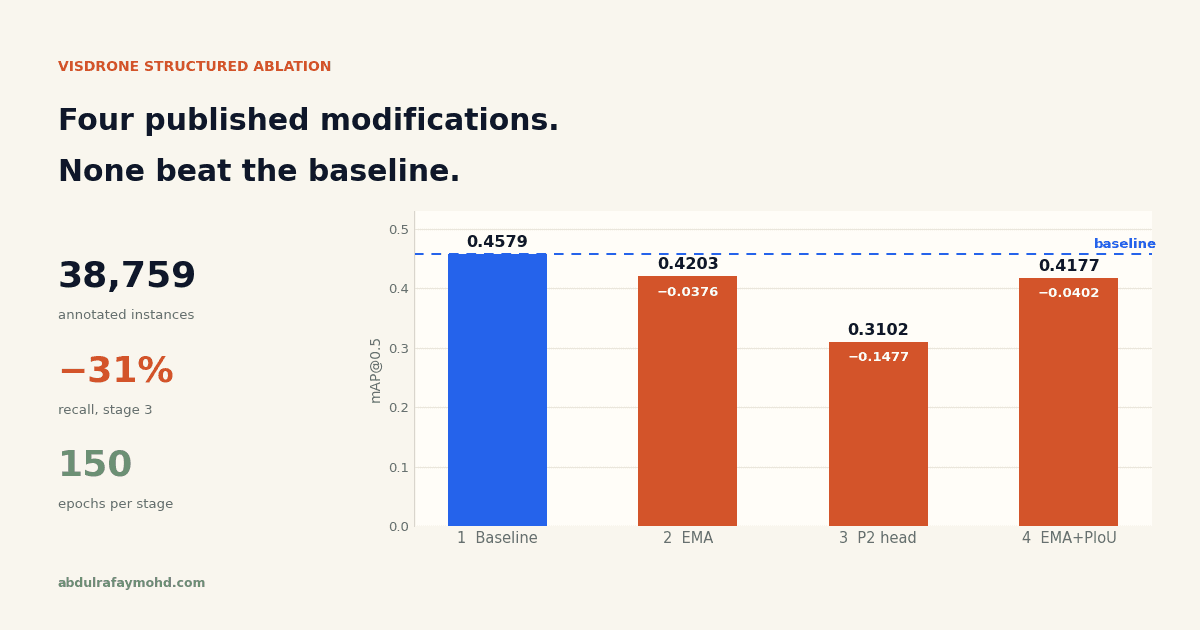
Four modifications from the UAV small-object detection literature — attention, a stride-4 detection head, PIoU regression reweighting, and inference-time tiling — applied to one YOLOv8-L baseline under a single protocol. None beat the unmodified model. The most-recommended fix cost 0.148 mAP50 and reduced small-object recall by 31%.
The 2012 architecture reproduced to the paper rather than to torchvision — the two-GPU grouped convolutions, LRN before pooling, and the bias initialisation that most implementations drop. Verified at exactly 60,965,224 parameters, with 33 questions the paper raised and how each one resolved.
The 1998 architecture reproduced faithfully in PyTorch — trainable subsampling coefficients, the C3 connection table, RBF output and MAP loss — verified at exactly 60,000 parameters. With 21 questions the paper raised and how each one resolved.
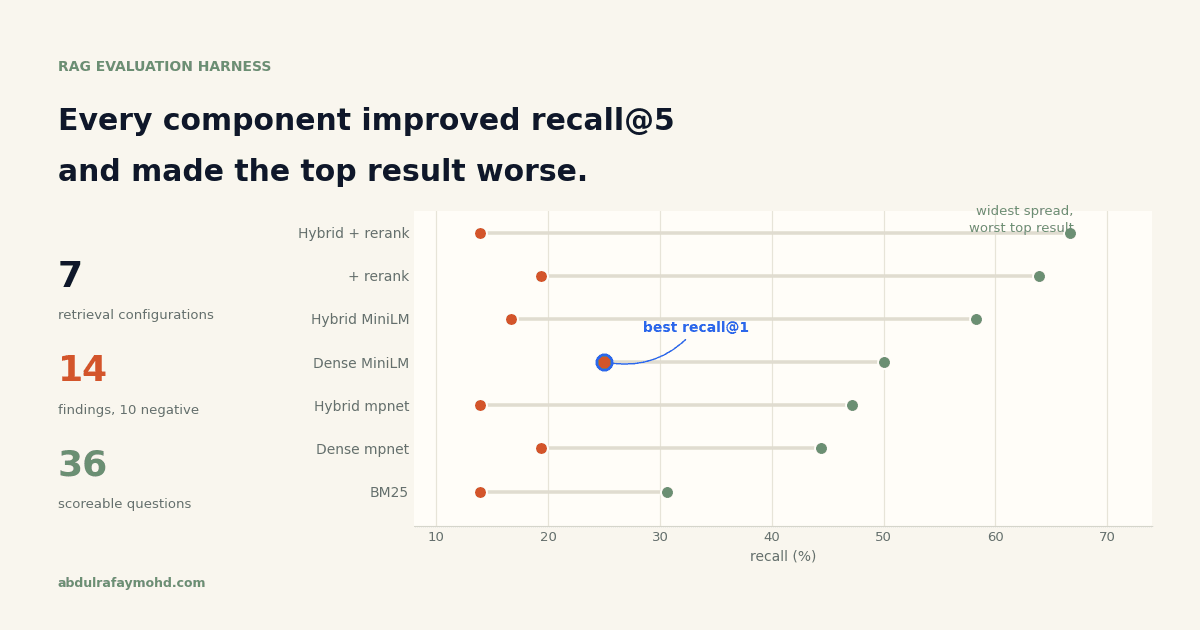
Seven retrieval configurations benchmarked against a hand-verified eval set over a corpus of computer vision papers. No configuration beat plain dense retrieval on recall@1 — every added component improved recall@5 while making the top result worse. 14 findings, 10 of them negative.
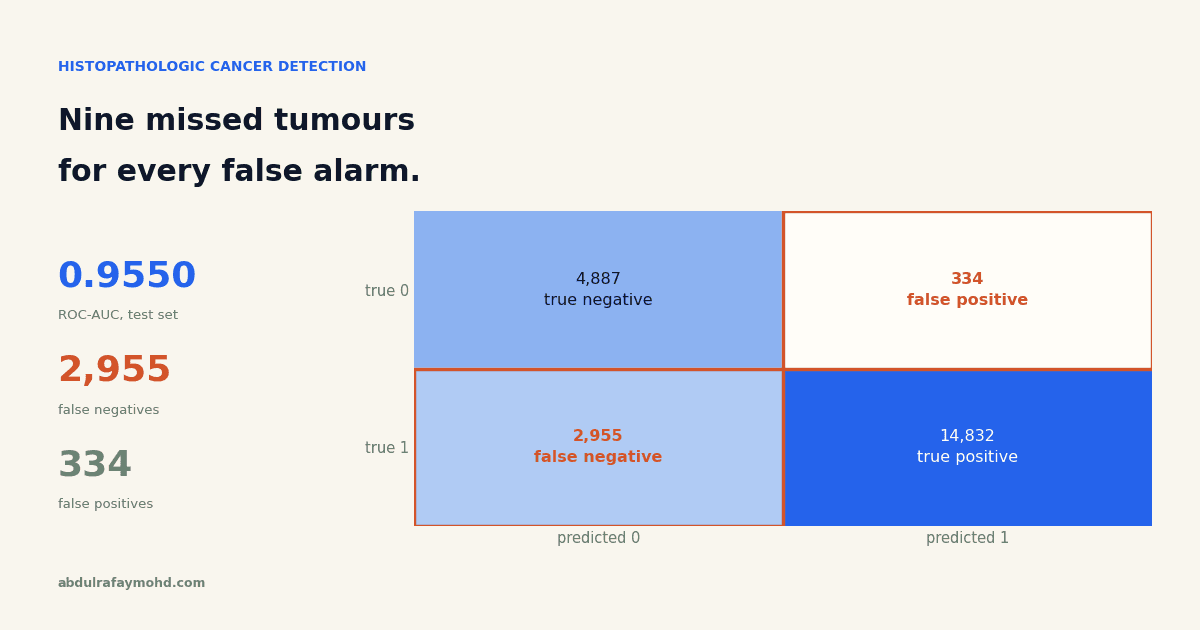
A Swin-Tiny Vision Transformer fine-tuned for binary tumor classification on PatchCamelyon histopathology patches, reaching ROC-AUC 0.955 and PR-AUC 0.99 at 85.7% accuracy. Evaluated on sensitivity and specificity rather than accuracy alone, because the false-negative cost in a diagnostic setting is not symmetric.
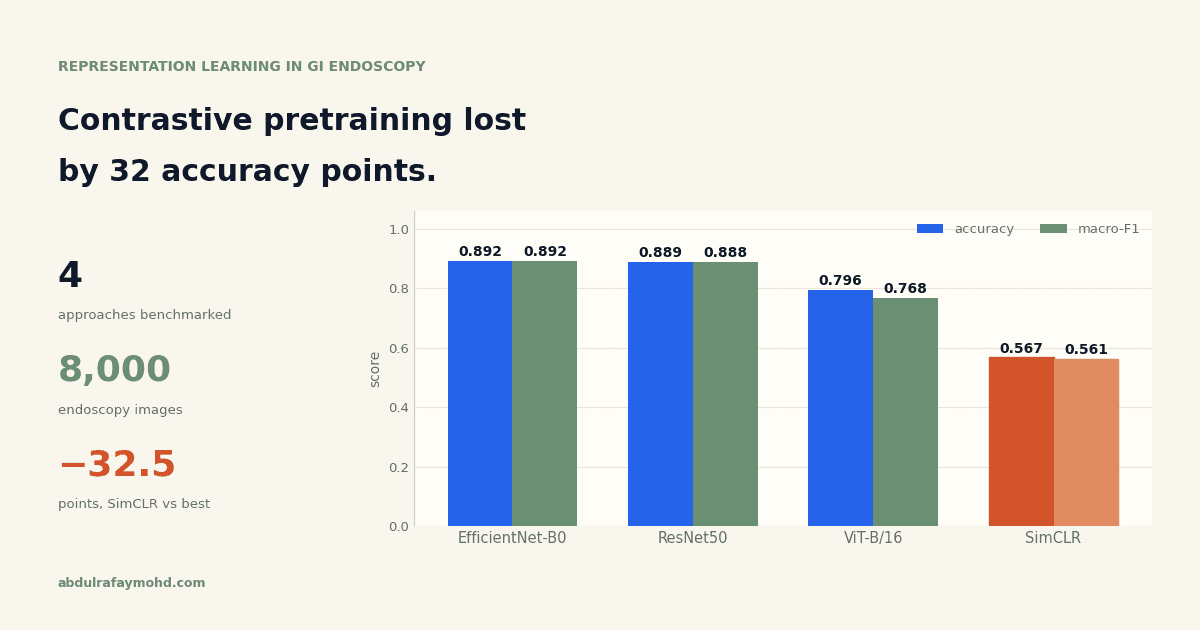
A controlled comparison of supervised transfer learning against SimCLR contrastive pretraining for gastrointestinal endoscopy classification, across ResNet50, EfficientNet-B0, and ViT-B/16. SimCLR reached 56.72% accuracy where supervised transfer reached 89.19% — and the vision transformer lost to both CNNs.